I was fortunate to find the time and budget (a modest augmentation from the University for assistant professors) to revisit my study sites in Thailand. This allowed me to take photos of the monuments and memorials discussed in my dissertation, which I will include in my book project. It was fortuitous that I proceeded with the trip, as I discovered a couple of weeks later that my book proposal was approved.
The last time I was in Thailand was in 2021 for a conference in Chiang Mai and in 2019 in Chiang Rai. I initially planned to conduct research in 2020, but the COVID-19 pandemic thwarted those plans. Consequently, my last visit remotely connected to my study was in 2017. Fortunately, I had good friends in Bangkok, fellow graduate students from my undergraduate years, who were able to access some literature and take photos of my study sites. Thus, this quick revisit was warranted. I booked the cheapest flights and hotel I could find due to my limited budget and the need to revisit Singapore in July, which will also incur expenses.
Fortunately, newly-minted PhD, Dr. Gil Turingan, was working in Bangkok during my visit. I was lucky because he was set to leave for Europe for a postdoc in a few months, but he still made time to accompany me. Interestingly, Gil was instrumental in my dissertation project. His paper on the Democracy Monument in Bangkok inspired me to explore war memorials in Thailand and the Philippines. The paper I wrote, which received a research grant from Chulalongkorn University in 2020, was inspired by his work. You can see him in the picture below.
Weeks before my visit, Thailand experienced an intense heatwave, and people were literally praying for rain. Raised under the Philippine sun and having endured hot Japanese summers, I came prepared. Bangkok’s efficient transportation systems and ride-sharing services made my trip much smoother. Upon arrival, I booked a ride and headed straight to my first destination, the monument to King Taksin the Great in Wong Wian Yai, pictured below.
What struck me was how visible yet inaccessible the monument was. Located in a roundabout, one might expect this park to be a popular hangout. Last time I was here, I only observed from afar, so this was my first close inspection. The area was deserted. I stayed for a bit to take photos and then left for my next destination: the Rama I Monument, pictured below.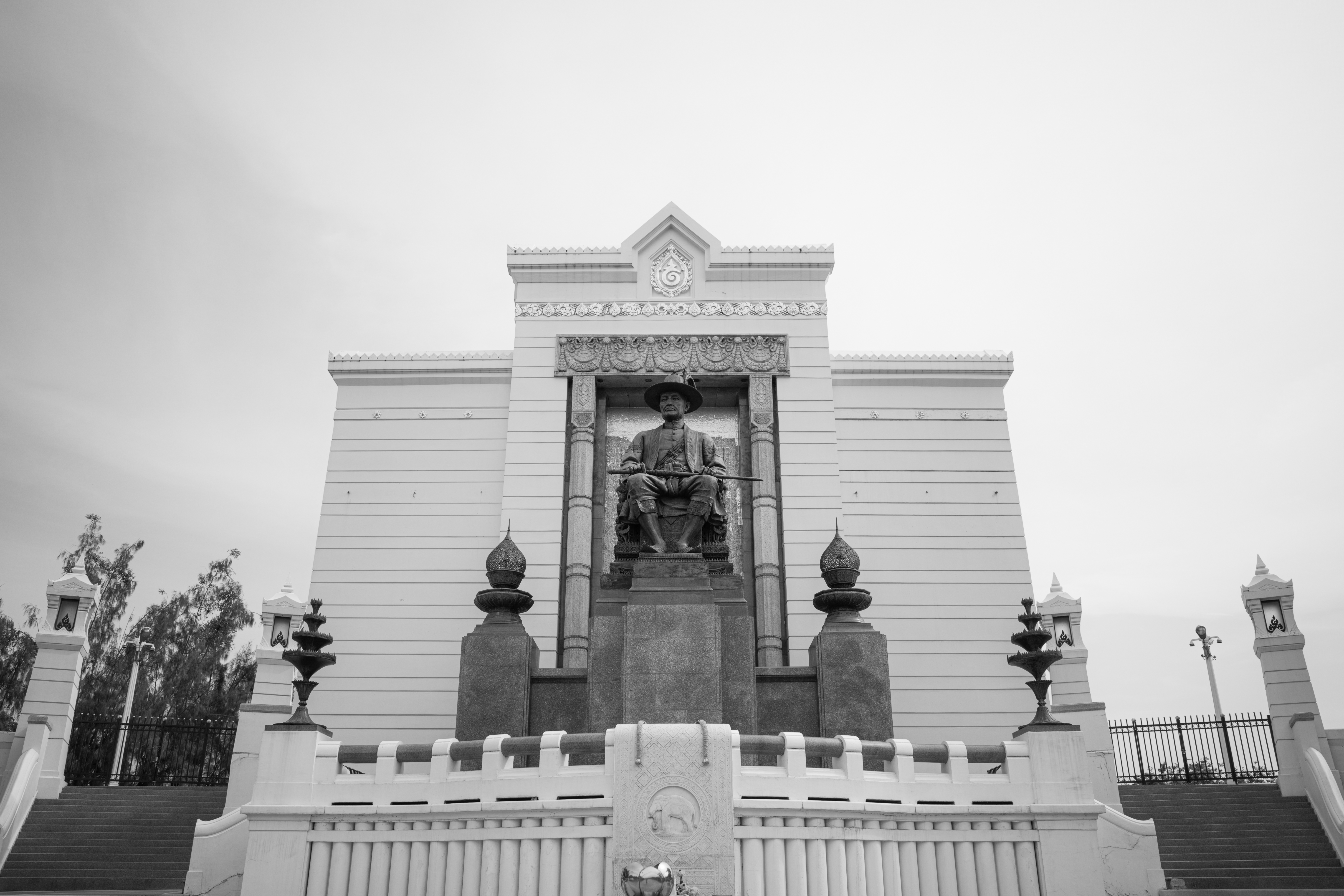
Again, this memorial was quite inaccessible. My driver asked if I could be dropped nearby as the monument was situated in an intersection delta fronting a memorial bridge. Crossing the road to reach the memorial felt quite unsafe. The memorial was grand, and like the Taksin monument, there was no one around here as well. After my visit, I returned to my hotel to rest, anticipating an early start the next day.
The following day, I met with Gil, who accompanied me to Suphanburi, some 150 kilometers away from Bangkok, to visit the King Naresuan Monument and Chedi. I opted not to brave public transportation, so I booked a car for the day trip. The two-hour drive was worthwhile. The monument was intriguing; like Taksin, Naresuan was a pre-Chakri dynasty king renowned for his battlefield prowess. Behind the monument, the Chedi (or stupa) houses a museum detailing the king’s adventures.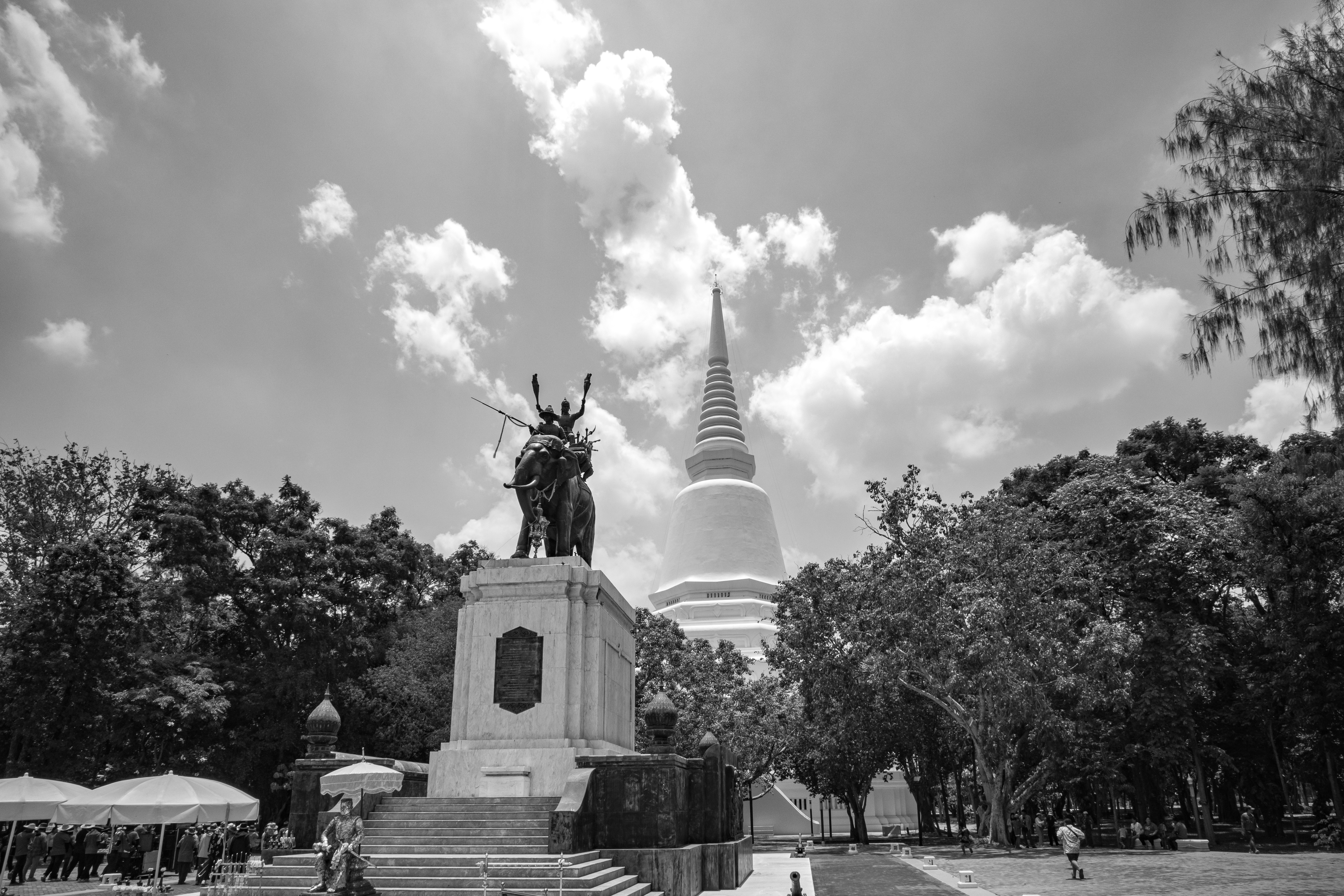
Unlike the first two memorials, this one had a more public atmosphere, with people milling around. However, similar to the other memorials, the public nature of these sites was due to their religious significance, as the king’s right to rule is perceived to originate from the divine (see devaraja and chakravartin for more detailed explanations). Religious offerings such as candles, incense, and flowers adorned the king’s statues. People approached the statue with religious reverence, praying and removing their footwear.
Back in Bangkok, we headed to the Equestrian Statue of Chulalongkorn. I was eager to visit this site because Chulalongkorn greatly valued monument-building and European-style urban planning in Thailand. Gil was also excited as he had never been there. Unfortunately, the Royal Plaza where the statue is located was fenced off, and photographs were prohibited. Despite this, it was satisfying to have seen the statue. It was believed that once a week, Chula’s spirit enters the monument, so there was a weekly gathering of Thai king adherents here to pray. For sure, the fencing off has limited that practice as well.
We then headed to the statue of Rama VI in Lumpini Park. Having visited this place before, I knew it was in a very public area. To my surprise, it was also fenced off, though there were no guards to prevent us from taking photos. Rama VI, or Vajiravudh, is known as the Father of Thai Nationalism, so it was disappointing not to capture more close-up shots. I’ll have to make do with the one below.
The next day, I met Gil again to visit the Victory Monument. Before this, we met at Chulalongkorn University, where Gil completed his PhD. He gave me a tour, and we saw the Two Kings monument in front of the university auditorium, depicting Chulalongkorn and his son Vajiravudh. Young people were praying in front of the monument, with their parents standing behind them. Gil explained that they were likely prospective students praying for admission, as it has become customary to do so, and that freshmen at the university take an oath at the monument as part of their initiation rites. Later, we relaxed at a café on campus and met with Park, my girlfriend’s friend, who is pursuing her PhD there. When she learned we were heading to the Victory Monument, she informed us, “It’s under renovation. You won’t see the statues.” I knew this beforehand, so I said it was okay. Park lives near the monument, which is situated in a roundabout near a central transportation hub. She expressed fascination with my study (and Gil’s) as these memorial sites in Bangkok are part of their everyday lives, yet they seldom pause to reflect on their significance.
We arrived at the Victory Monument to find the statues covered, as pictured below. It was a bit disappointing, but Gil had already taken photos of the monument before, which I included in my dissertation. Later, Gil and I stayed at a café to discuss potential collaborations. We found exciting opportunities for comparative Thai-Philippine studies and a Thai Studies paper to work on.
On my last day in Bangkok, I visited the World War I Volunteer Monument in Sanam Luang. Aside from the Victory Monument, this is the only other expressly dedicated war memorial in the city. Tucked away in a delta, a line of buses was parked along most sides of the triangle where a traditionally Thai stupa is placed. See below for the picture.
This visit was a great experience for me, as I am reminded of the intricate layers of history, memory, politics, and identity embedded within these monuments. Each site, whether bustling with activity or quietly standing in solitude, offers a unique lens through which to view Thailand’s complex past and present. The accessibility or inaccessibility of these memorials, their religious connotations, and their evolving significance in the urban landscape underscore the dynamic interplay between public memory and national identity.
As I move forward with my book project, these firsthand experiences and observations will surely enrich my analysis, providing a deeper understanding of how these monuments function not only as commemorative spaces but also as living elements of cultural heritage that are highly political. I was also happy to reconnect with Gil, and talk to a local, Park, about what these sites mean to them.
I look forward to sharing these insights and stories in my upcoming book, in hopes to contribute meaningfully to the discourse on memorialization and historical memory in Southeast Asia.

From the Field: Bangkok and Suphanburi, May 2024
 JOHN LEE CANDELARIA
Leave a comment